Geology is a field of science that studies the Earth and specifically the Earth’s crust: its history, structure, composition, and the processes related to its formation, as well as its on-going processes. Physics, biology, and chemistry are all applied in geological studies.
As a field of research, geology has a long history in Finland. The Geological Survey of Finland continues the work started by the Geological Office established under the Board of Mines in 1877. The predecessor of the Board of Mines was its Swedish counterpart established in 1630.
The word ‘geology’ comes from the Ancient Greek words of γῆ, gē (“earth”) and -λoγία, -logia, (“study of”, “discourse”).
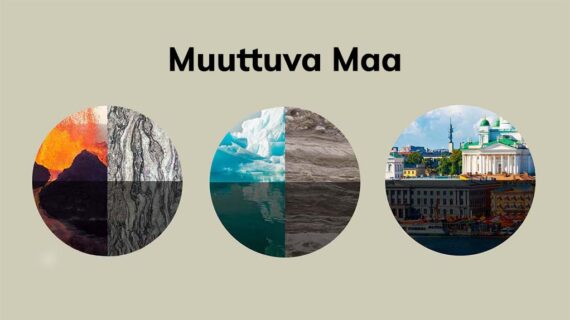
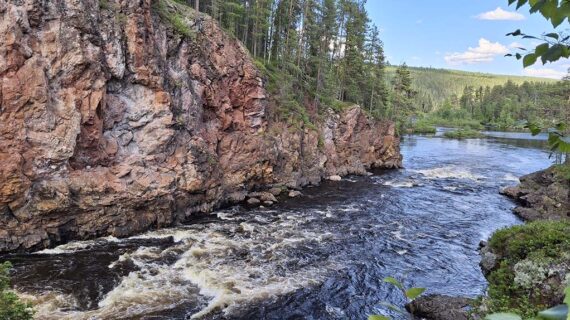
Geological Survey of Finland welcomes you to virtual time travel to the early stages of the Earth’s evolution by studying Finnish bedrock. The area presented is the Kuhmo greenstone belt in Eastern Finland. The Fennoscandian Shield has attracted international attention too, due to the fact that crystalline bedrock is widely and well-exposed, rather than buried beneath younger sedimentary formations.
Have you ever stopped to think how many of the things around us are connected to geology? Metals, glass, porcelain, concrete, and many other raw materials used in construction and for energy – not to mention the water we drink – all originate from the Earth’s crust.
When an early human first took a sharp rock and figured out how to use it as a tool during the Stone Age, humanity instantly became dependent on the Earth’s crust. Today, we use a plethora of metallic devices produced from ore. We use rock materials, such as sand and gravel, limestone and other minerals to build houses, roads and all sorts of buildings and structures. Plastics and many fuels and lubricants are produced from oil found underground.
The crust also provides us with energy. We use refined uranium as fuel for nuclear energy plants, and we burn peat, coal and oil to produce electricity and heat. Geothermal energy is widely used for heating and cooling buildings.
Groundwater is a vital geological resource that Finns have an abundance of (for now). However, around a third of the Earth’s population is suffering from fresh water shortages.
Geological natural resources include minerals, and energy or other resources stored within them, that are valuable or vital to humans. Geological natural resources used in construction, manufacturing or as other production materials are also called raw materials.
A lot of geological understanding and information produced from research are required to keep the modern society running. Today, the most current research areas are the utilisation of battery minerals and circular economy solutions.