Skip to content

How to Find and Study Rocks?

An amateur geologist does not need expensive equipment to search and find samples. However, a few basic pieces of equipment are required. Also, planning the search trips well in advance makes it easier to find samples.

How to identify a typical ore rock?

An ore rock is a type of rock that contains so much metal or mineral that it could be economically viable to extract. Ore rock can be identified by the following features:

Metals oxidize, or “rust”

This is why many ore rocks, especially iron-rich ones, appear rusty. The rock may be reddish-brown, orange, or mottled.

Heavy and sometimes magnetic

If a rock feels surprisingly heavy for its size and attracts a magnet, it may contain iron.

Unusual color

Shades like green, blue, or silver may indicate the presence of copper, cobalt, or other metals.

Metallic luster or colorful specks

The rock may show shiny or colorful, metallic-looking spots. Sometimes it may even have flecks that resemble gold or copper. However, not everything that sparkles is valuable. For example, mica minerals like biotite can weather into a golden-yellow color, which is why the term “fool’s gold” is used in everyday language.

Streak color

A more reliable identifier than the rock’s surface color is its streak color. This is revealed by scraping the rock against a fuse or unglazed porcelain, which grinds mineral powder onto the surface. Transparent or translucent minerals have a white streak. Dark minerals that are not ore minerals usually have a streak lighter than the mineral itself. A streak darker than the mineral’s color typically indicates a metallic-luster mineral.
  • The website geologia.fi also offers useful basic information about geology in Finnish, which can help in identifying rocks.

The basic equipment for amateur geologist

  • A rock hammer for breaking rocks and a pair of safety glasses to protect against the chips that fly off.
  • Unglazed porcelain (a ceramic fuse, for example) can be used to find out the colour of a mineral’s streak.
  • A steel spike or a common steel nail can be used to determine the hardness of a mineral.
  • Magnetism can be determined with a magnet or a compass.
  • While hiking in the woods, it is recommended to always have a compass or a GPS device with you. It also makes saving the sample locations and marking them in the terrain easier.

How to plan a search trip?

Plan the search trips well in advance. In addition to a basic map, it is useful to find some geological maps of the planned search area. These can be found at GTK’s Hakku service, for example.

It is also worth downloading GTK’s OmaKivi app to your phone, so you can immediately record details about your find while still out in the field. More information in How to Collect and Send Layman’s Samples? section.

Where can you collect rock samples?

The best places to search are areas where felling, drainage or road construction work has been done recently – or any other work that requires digging into the soil – since these areas tend to have plenty of exposed rocks and bedrock.

While planning your routes, keep in mind proper forest etiquette and avoid areas near people’s houses and yards. Taking samples on a small scale is allowed under the Finnish mining legislation. It is polite to inform the landowner of the area you plan to search for samples in and, if necessary, ask for their permission to collect the samples.

Collecting rocks and other soil materials is generally prohibited in national parks and nature reserves.

Tips to identify rocks and minerals

To help identify rocks and minerals, you can use tools such as a magnet, a nail, and a fuse.
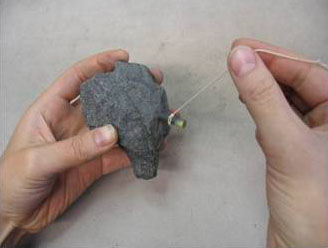
The person holds a stone in their left hand and a magnet on the end of a string in their right hand, which is used to test the stone's properties.
A magnet can be used to identify magnetic minerals, such as magnetite and pyrrhotite.
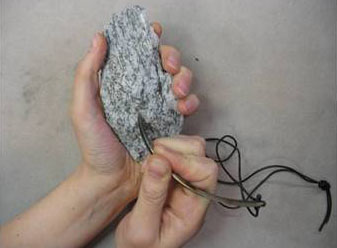
A hand holds a rock sample while the other hand uses a hook tool to scratch its surface.
The hardness of minerals varies. Hardness can be determined with an ordinary nail, for example.
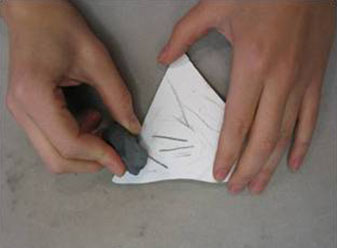
Hands scratching a white porcelain piece with a black rock.
The colour of a mineral’s streak can be determined by scratching the sample with a steel spike or making a streak on an unglazed porcelain surface (e.g. a ceramic fuse) with the sample.

Information about mineral properties is also found on the geologia.fi website in Finnish.