
More Accurate and Precise Mapping of Critical Raw Materials Is Now Possible at Geological Survey of Finland
The two newest instruments in the isotope laboratory of the Geological Survey of Finland (GTK) enable more accurate and precise quantification of critical raw materials such as REE phases, sulfides, and battery materials. The recently acquired time of flight (TOF) mass spectrometer and femtosecond laser and the previously acquired multicollector mass spectrometer complement each other perfectly. This setup with skilled GTK researchers takes the laboratory to the top tier in the field globally.
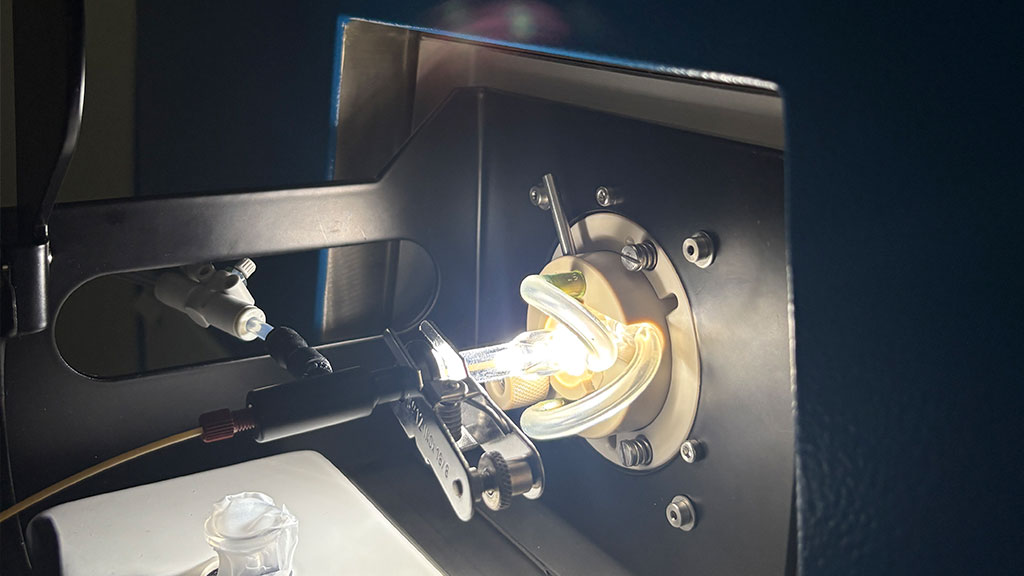
Applied mineralogy and isotope geology are key aspects when studying the bedrock and investigating ore potential in all stages of the assessment and development of ore deposits. Furthermore, mineralogical and isotope studies can be applied extensively to the characterisation of other geological materials and circular economy materials.
“The new equipment significantly advances the laboratory’s capabilities for critical raw material research,” says Marja Lehtonen, Head of the Circular Economy Solutions Unit at GTK.
The two pieces of equipment were funded by the Research Council of Finland. For the time being, the set of equipment is used mainly in academic collaboration projects but is also used for analyses for GTK’s partner organisations. It is also available for customer projects.
New possibilities for Rare Earth Element research
For analysis, the rock sample is first placed in the femtosecond laser that ablates material from a tiny micrometer spot on its surface to form an aerosol. Typical lasers send a pulse lasting a nanosecond (one billionth of a second (10⁻⁹ seconds)) but the femtosecond laser can send a very short light pulse lasting only a few femtoseconds (one quadrillionth of a second (10⁻¹⁵ seconds)).
“In addition to the process getting faster, another benefit is that the sample suffers hardly any heat damage. The much shorter width of the laser pulse makes the mechanism of the ablation completely different and more predictable. This helps for example in the research of Rare Earth Elements (REE) since the quantity of the material is usually very small and no reference materials are available,” says Stepan Chernonozhkin, Senior Researcher, GTK.
Also, sulphides and sulpharsenides, that melt easily, can now be studied. These minerals are important indicators for deposits such as cobalt or gold.
Time of flight measures entire periodic table at once and rapidly
The sample aerosol ablated by a femtosecond laser can be studied with a time-of-flight (TOF) ICP mass spectrometer. The sample is transferred as an aerosol to a plasma torch to be ionised. They form an ion beam that goes to the mass spectrometer.
The ions are accelerated to constant energy and fly down to the detector. Depending on their mass, the ions move at different speeds. The detector counts how many ions arrive each nanosecond. And as a result, the time of flight can be recalculated to the mass of an ion, or simply which element it corresponds to.
The benefit of this type of mass spectrometry is that you can measure the entire periodic table in every laser shot, and you don’t have to preselect which elements are studied.
“That way we can find something we were not expecting to find. And as with the femtosecond laser, one benefit is the speed,” says Stepan Chernonozhkin.
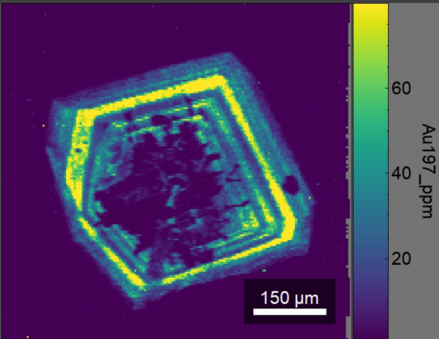
Ultimately, the new setup of a femtosecond laser and time of flight mass spectrometer allows visualisation of trace element distribution at unprecedented rate with a resolution of less than 10 micrometres, as shown for example for gold distribution in an arsenopyrite grain (see picture).
More information
Research on Mineral Traceability Expands with New, More Accurate Analysis Equipment
Marja Lehtonen, Head of Unit, Circular Economy Solutions
Geological Survey of Finland GTK
tel. +358 29 503 2183
marja.lehtonen@gtk.fi
Heli Lallukka, Laboratory Manager
Geological Survey of Finland GTK
tel. +358 29 503 0197
heli.lallukka@gtk.fi