
Railway Ballast Demonstrates Better Long-Term Durability Than Expected
Geological Survey of Finland GTK, Tampere University, and aggregate producers carried out a joint study on how rock mineralogy and texture influence the mechanical strength and long-term durability of railway ballast. The rock aggregates examined met the mechanical durability requirements for track ballast better than anticipated, even though the proportion of soft minerals and ore minerals was high in some cases. The results provide new insight for assessing the long-term durability and regional availability of aggregates.
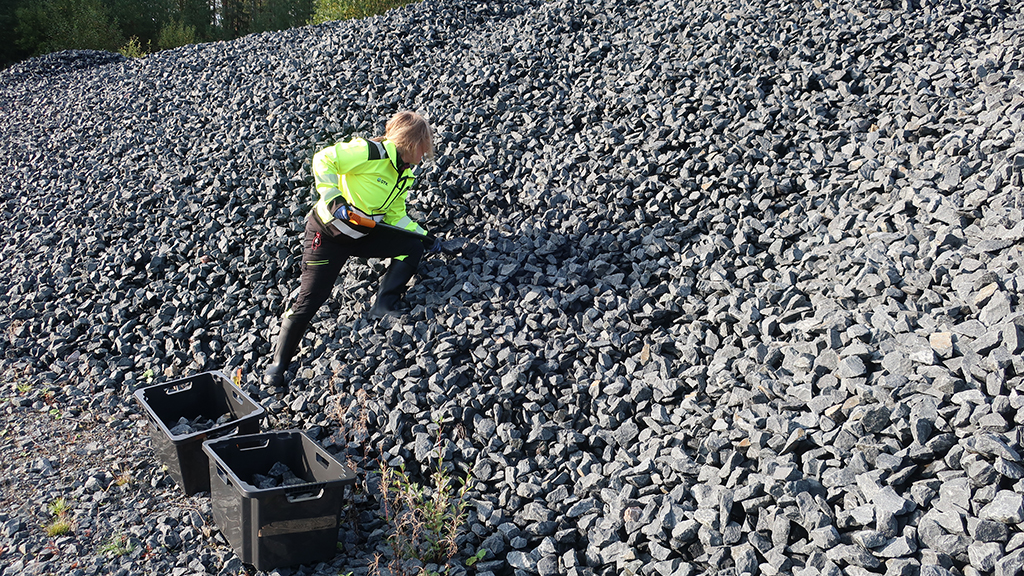
The purpose of railway ballast is to support the railway laterally and vertically and to maintain its correct geometric position. Since the service life of railway ballast should be approximately 40 years, rock aggregates are subject to strict requirements for mechanical durability and upper limits for certain mineral contents. These limits concern mainly the maximum permitted proportions of so-called soft minerals and ore minerals, and their influence on rock aggregate weathering and electrical conductivity.
In Finland, there are concerns over the regional availability of suitable aggregates for railway ballast, particularly because of strict mineralogical requirements. The project ′Developing Quality Requirements for Railway Ballast’ (RaGe) examined the correlation between mineralogical requirements and long-term durability.
Rock aggregates withstood stress tests despite high ore mineral content
The study investigated the long-term durability of rock samples collected from seven rock quarries using freeze–thaw testing. All rock aggregates examined performed well under freeze–thaw stress of up to 40 cycles, even though samples from at least two quarries contained high proportions of soft minerals and samples from most sites exceeded 5% ore minerals. These opaque minerals were predominantly oxidic ore minerals.
According to the results, the generally good strength of the rocks is likely explained by their fine-grained texture: the average grain size of the groundmass minerals was typically below 0.1 mm, and the grain boundaries between mineral grains withstood impact and abrasion well. At a few sites, deformation of the rocks combined with simultaneous hydrothermal alteration may also have enhanced mechanical strength.
The results further indicate that the freeze–thaw stress tests currently in use do not fully demonstrate rock durability over timescales of several decades. The researchers recommend developing multi-cycle laboratory testing, especially in cases where rock aggregates contain moderate to high proportions of soft minerals and ore minerals.
Recommendations for developing railway ballast quality requirements
The study presents several recommendations for improving quality assessments, including more comprehensive geological mapping of quarries, better utilisation of spatial data in quality control, and improved representativeness in sampling for petrographic studies together with more precise mineralogical analyses.
In addition, mineralogical requirements for rock aggregates and alternative analytical methods should continue to be developed. The study also recommends further research on the electrical conductivity of railway ballast and on rock aggregates containing sulphide minerals.
The ′Developing Quality Requirements for Railway Ballast′ project was carried out in cooperation with Tampere University’s Research Centre Terra. The project was funded by the Finnish Transport Infrastructure Agency (Väylävirasto) and aggregate producers Peab Industri Oy (Swerock), Rudus Oy, Destia Oy, Savon Kuljetus Oy, Morenia Oy, and Sundström Ab Oy.
Further information
Heli Kivisaari, geologist
Geological Survey of Finland GTK
heli.kivisaari@gtk.fi
Report of the Developing Quality Requirements for Railway Ballast (RaGe) project has been published on the Finnish Transport Infrastructure Agency’s website (summary available in English):
Developing Quality Requirements for Railway Ballast: Rock Mineralogy, Texture and Long-Term Durability
Get to know GTK services: Rock Aggregate Studies and Circular Economy of Aggregates