
Combining Solar Power and Rewetting on Former Peatlands Can Deliver Real Climate Benefits
A new study by Geological Survey of Finland GTK shows that combining solar power generation with peatland rewetting on former peat extraction sites is widely feasible and can significantly reduce the climate impacts of land use. Local and regional analyses indicate that rewetting clearly lowers greenhouse gas emissions from peat soils compared to solar installations maintained under dry conditions.
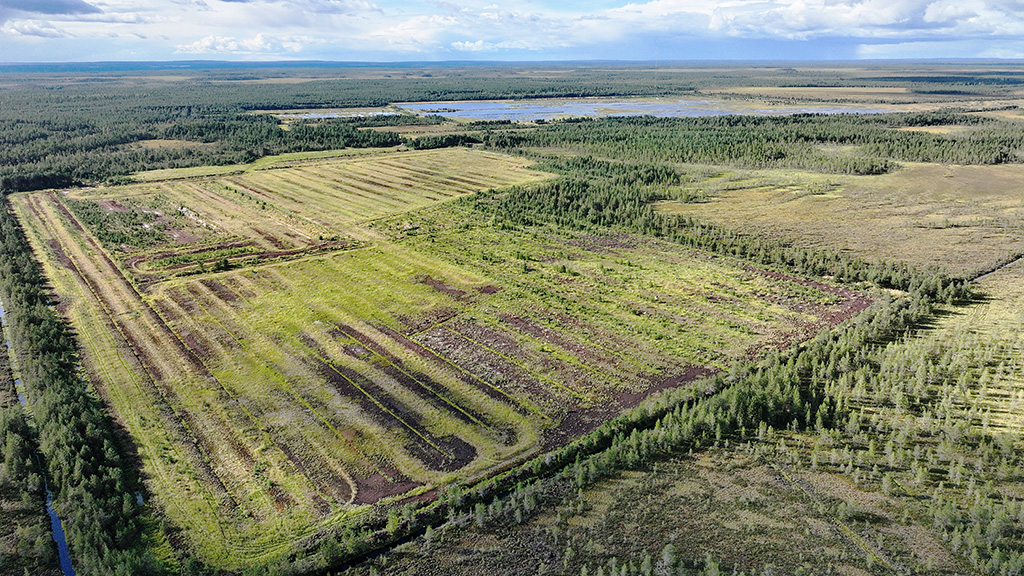
The study examined the potential for solar energy production on rewetted peatlands through a single pilot site and a regional-scale assessment.
“The results show that by combining solar power with rewetting, areas released from peat extraction can be used for renewable energy generation while simultaneously reducing the warming impact of land use. This is an important message for regions with large peatland areas,” says senior scientist Lauri Ikkala from GTK, who led the study.
The research was carried out as part of the European Union funded REPower-CEST project, which aims to advance the transition to a clean energy system in Finland.
Pilot study highlights the importance of rewetting for climate impacts
The local case study focused on the Ruonasuo site in the municipality of Simo. At this former peat extraction site, the thickness of the peat layer, the underlying mineral soil type, surface water flow pathways, and the feasibility of rewetting were assessed.
The results showed that the peat layer thickness at the site is mainly less than 1.5 metres, and the subsoil is suitable for pile foundations—the most common foundation type for solar panel installations. The topographic conditions and the extent of the catchment area provide favourable conditions for rewetting through water level control using dams.
At Ruonasuo, more than half of the site’s carbon stock was identified as potentially rewettable by damming. Rewetting could nearly halve soil emissions at the pilot site, as carbon is released into the atmosphere when drained peat decomposes.
The climate impact calculations were based on emission data compiled by GTK and a calculation methodology for different after-use options for peat extraction areas, recently published in a peer-reviewed scientific article.
Regional analysis: extensive potential in Central Ostrobothnia
To generalise the local findings, the study included a regional geospatial analysis in Central Ostrobothnia. Data on the characteristics of peat production fields and the feasibility of rewetting were compiled and updated in the recently completed Sustainable After-Use of Peat Production Areas (TURKE) project.
The new analysis focused specifically on peatland cutaway areas suitable for solar power development. More than 3,000 hectares of former and active peat extraction areas were assessed, where sufficient data were available on peat thickness, subsoil type, and surface elevation.
The results indicate that approximately half of the assessed peat extraction areas in Central Ostrobothnia would be suitable for solar power installations based on peat thickness and subsoil conditions. Of these areas, up to 90% were estimated to be suitable for rewetting in a way that would maintain part of the carbon stock under wet conditions.
Thus, at the regional scale, the climate impacts were consistent with those observed at the pilot site.
Rewetting requires site-specific planning
Solar power development is being planned for former peat extraction areas, but to date most experience is from drained peatlands. In many cases, solar energy construction and peatland rewetting could be combined to achieve climate benefits, but this requires careful, site-specific planning.
In particular, risks related to acid sulfate soils, impacts on water quality, and specific characteristics of the construction phase must be considered at an early stage.
“Combining solar power and rewetting is not a one-size-fits-all solution; it always requires site-specific geological and hydrological information. GTK’s role is to provide baseline data and support the development of sustainable solutions,” Ikkala concludes.
Further information
Lauri Ikkala, Senior Scientist
Geological Survey of Finland GTK
lauri.ikkala@gtk.fi
Research report on GTK’s Hakku data service (available in Finnish):
Aurinkoenergiaa vetetyille turvemaille – Paikallisia ja alueellisia tarkasteluja REPower CEST hankkeessa
Peer-reviewed article on climate impacts of after-use options:
Peat cutaway properties define after-use options and capacity for climate regulation.
Maanavilja, L., Allonen, O., Aro, L., Sutinen, H., Vähäkuopus, T. & Laine, A. M. 2026. Environmental Management. Online first.
Regional report on GTK’s Hakku data service (summary available in English):
Potential for different after-uses and the carbon content of peat in peat extraction areas in Central Ostrobothnia
The European Union funded REPower-CEST project supports the transition to a clean energy system by generating knowledge on the environmental impacts of renewable energy and on ways to reduce the climate impacts of land use, particularly in peatland-dominated regions. For more information, visit the project website in the Finnish Environment Institute’s online service