
GTK Examines the Impacts of Restoring Nutrient-Rich Peatlands at Raakunsuo in Ranua
The Geological Survey of Finland GTK is investigating the impacts of restoration at a former peat production site of Raakunsuo in Ranua, Northern Finland. The research examines how restoration has affected greenhouse gas emissions, water quality, and vegetation in the area. Nutrient-rich peatland sites such as Raakunsuo have so far received limited research attention in Finland, even though their restoration may play a significant role in supporting biodiversity conservation.
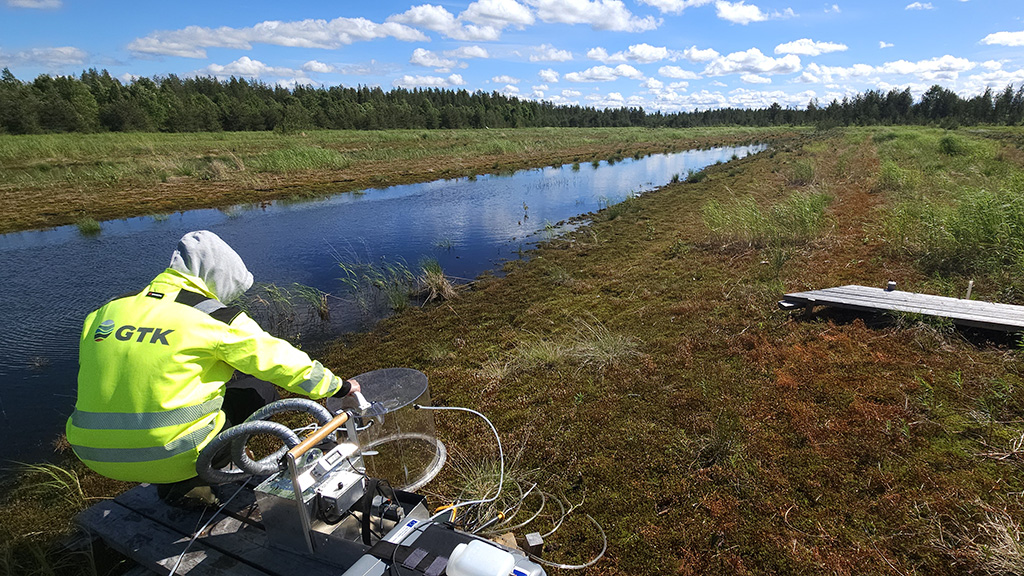
Raakunsuo is located along the river Simojoki. Before drainage for peat extraction in the 1990s, the site was an aapa mire characterised by rich fen patches and springs. Peat production at the site ended in 2020, and restoration measures began in 2025 as part of the Suokeidas project by the Finnish Natural Heritage Foundation and the John Nurminen Foundation.
GTK became interested in Raakunsuo due to its originally nutrient-rich and spring-fed character, as restoration of peat production areas in Finland has so far primarily focused on more oligotrophic sites. Research on more fertile peatlands remains limited, even though restoration of such areas could help re-establish threatened fen and spring species and thus generate significant ecological value. In addition to improving understanding of the environmental impacts of restoration, GTK’s research provides knowledge on effective restoration methods for nutrient-rich sites.
Research focuses on climate and environmental impacts
The studies on Raakunsuo focus particularly on the impacts of restoration on water bodies and greenhouse gas emissions. GTK’s fieldwork at the site began in June 2026 with the construction of study plots. During the summer, greenhouse gases (methane and carbon dioxide) are measured in the wetland littoral zone, in areas where Sphagnum moss has been transplanted, and on peatland where the water table has been raised close to the surface. At the same sites, peat nutrient contents, carbon stocks and peat thickness will be analysed, and the surface vegetation mapped.
Impacts on water bodies are examined across different parts of the mire by monitoring water quality and the darkening of waters flowing into and out of the site. Groundwater effects are investigated using isotope analyses. Measurement data are complemented with drone-based surveys, including multispectral imaging and InSAR methods, providing a comprehensive picture of the condition of the entire mire area.
The research will expand the knowledge base on restoring originally nutrient-rich peatlands, supporting more effective targeting of restoration measures in the future. At the same time, it will generate information needed for the EU Nature Restoration Regulation, Finland’s National Restoration Plan, and the development of biodiversity markets.
The studies are carried out as part of GTK’s self-financed ENGEO project, which supports the sustainable use of natural resources, ecological compensation, and the effective allocation of activities to optimal areas based on research data.
Further information
Matti Laatikainen, Team Manager
Geological Survey of Finland GTK
matti.laatikainen@gtk.fi
Maija Lampela, Senior Scientist
Geological Survey of Finland GTK
maija.lampela@gtk.fi
Project introduction on GTK’s website:
ENGEO 2026–2027
Find out about GTK’s service:
Measurement and assessment of carbon stocks and greenhouse gas balances of mires and peatlands
Read and download GTK’s policy brief (pdf file):
Restoring Peatlands on Private Land Requires Enabling Policy Instruments and Local Action